Past initiatives

Eleven attempts, one referendum

Since 2010, citizens have made eleven serious attempts to force a national referendum by collecting signatures. In ten cases out of eleven, more than 90%, there was no vote.

Behind every attempt was a problem people wanted to solve by voting. You do not have to agree with any of these questions. What matters is that hundreds of thousands of citizens asked for a vote on them, and no vote took place.

Older initiatives, such as those on the Hague Tribunal (2007), NATO (2008) and the arbitration with Slovenia (2009), collected between about 124,000 and 300,000 signatures according to available data and did not reach the threshold.[13]

  • 1 time a referendum was held
  • 4 times there were enough signatures, but the Constitutional Court banned the referendum
  • 4 times there were too few signatures, according to the count
  • 2 times the Government finally gave way, so there was no vote

In total the Government finally gave way four times: it withdrew amendments to the Labour Act (2010), dropped outsourcing (2014) and the motorway concession (2015), and accepted the demands of the initiative “67 je previše” (2019). Citizens won these changes themselves: the Government gave way only after hundreds of thousands of people had signed a request for a referendum. For outsourcing and the motorways the Constitutional Court later banned the referendum anyway, so those two are counted in its group.

Three obstacles that keep coming back

  1. The 10% threshold It is too high and keeps changing. For one initiative it changed in the middle of collection.
  2. The 15-day period Today about 24,000 signatures have to be collected every day. The kuna initiative collected more than 22,000 a day and still failed.
  3. The authorities' response Four times there were enough signatures, but the Constitutional Court banned the referendum (in two of these the Government had also given way). Twice the state did not recognise enough signatures. Twice even the number of signatures given by the organisers themselves was below the threshold. And twice more the Government finally gave way before a vote.

They were between 3 and 37 hours short

Four initiatives failed only on the number of signatures. Each collected more than 330,000, far more than 180,000 signatures. Measured by their own collection pace, each was less than two days of collecting short. If they had had at least one more day, they would probably have passed the threshold.

  • Narod odlučuje (1st question) 2018
    3,290 signatures short, about 3 hours
  • Electing MPs by name 2014
    23,603 signatures short, about 22 hours*
  • Istina o Istanbulskoj 2018
    28,798 signatures short, about 30 hours
  • Protecting the kuna 2021
    34,285 signatures short, about 37 hours*

My calculation: the number of recognised signatures divided by 15 days gives the average daily pace, and the shortfall divided by that pace gives the time that was missing. The real pace is not the same every day, so these are estimates. *For these two initiatives there is no official count of recognised signatures, so the number published by the organisers is used.

Ten percent of what? A number even the state did not always know

Ten percent of what? A number even the state did not always know

“Ten percent of voters” is not a number you can read in the law, and it is different every time:

  • 2014 404,252
  • 2018 374,740
  • 2019 373,568
  • October 2021 368,867
  • December 2021 368,446

The exact number becomes known only on the first day of collection, and a difference of a few thousand signatures can decide the outcome. In 2014 one initiative collected 380,649 signatures. Only after collection did the Ministry of Administration report how many voters there had been on the first day, and the Constitutional Court determined from that a threshold of 404,252 signatures.[9]

  • The threshold changed in the middle of collection. In May 2013 the initiative U ime obitelji assumed it needed about 375,000 signatures, because in April the Minister of Administration had announced about 3.74 million voters on the list for the European Parliament elections. On the twelfth day of collection the chair of the parliamentary Committee on the Constitution announced that 4,514,984 voters counted and that about 451,000 signatures were needed.[8]
  • The state had several numbers for the same voters. On 20 November 2013 the register held 4,080,386 voters in Croatia. Two days later the final voter list for the marriage referendum had 3,773,850.[9]
  • Not even the Constitutional Court had checked it before. In December 2014 it found that it had never before examined whether the 10% threshold had been met, and only then ordered that the exact number be published on the first day of collection.[9]
  • The register holds more voters than there are adult residents. In mid-2023 there were 3,645,340 voters, almost 470,000 more than the adult residents counted in the 2021 census.[19] “Ten percent of voters” is therefore in reality about 11.5% of the adults who live in Croatia.

Four times there were enough signatures, but the Constitutional Court banned the referendum

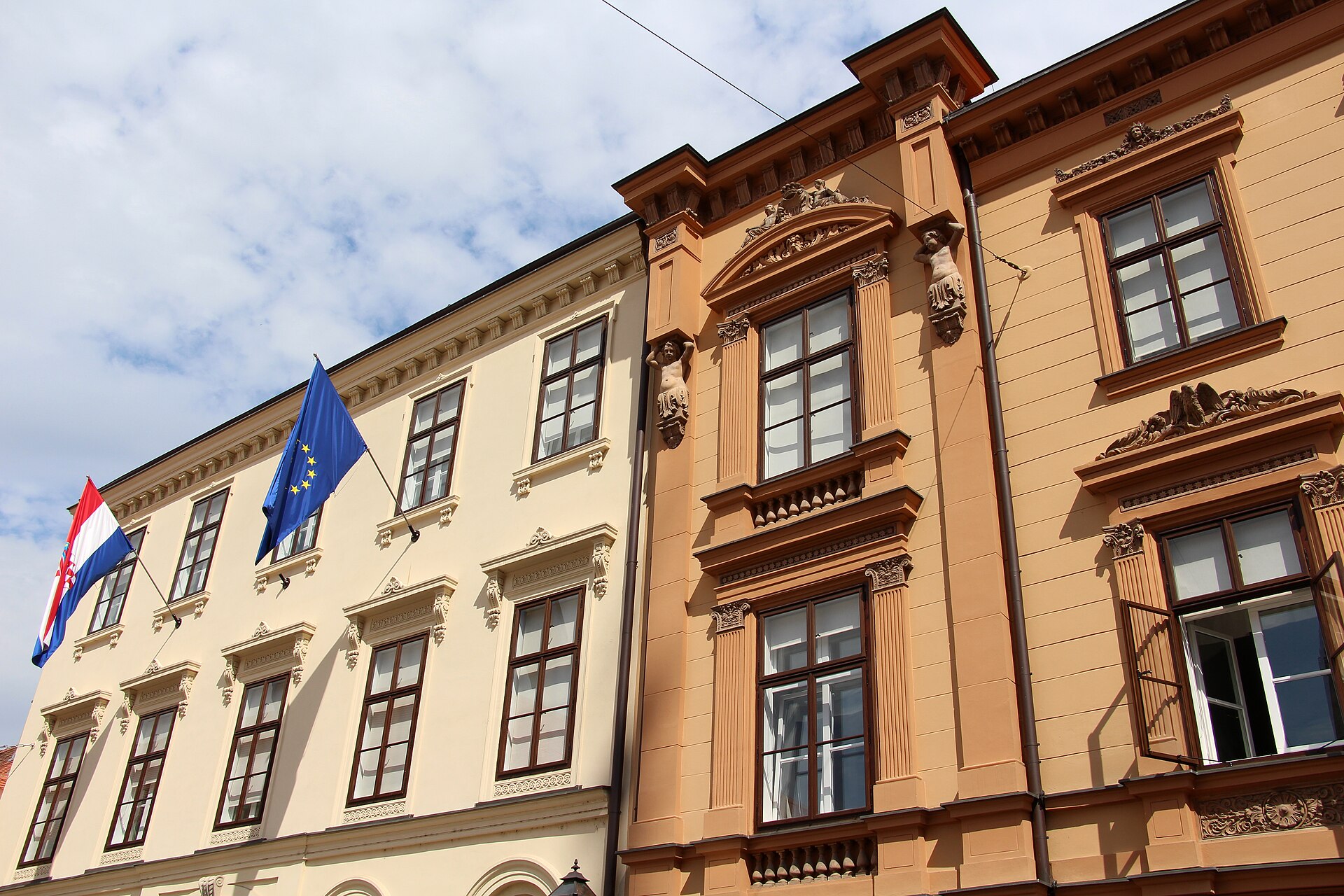
Facade of the Constitutional Court building in Zagreb
The Constitutional Court building on St. Mark's Square in Zagreb. Photo: Fred Romero / Wikimedia Commons, CC BY 2.0, resized.

Four initiatives had enough recognised signatures, but the Constitutional Court banned the referendum each time:

  • 12 August 2014 – Cyrillic script (576,388 recognised signatures)
  • 8 April 2015 – outsourcing (563,815)
  • 21 April 2015 – motorways (498,545)
  • 16 May 2022 – Most, both questions (370,310 and 372,635)

Together, that is almost 2.4 million recognised signatures that did not lead to a vote.

The Court's reasoning is given with each initiative below. A few facts about these rulings:

  • The Court rules on a referendum question at the request of Parliament.[20]
  • All thirteen judges of the Constitutional Court are elected by Parliament, by a two-thirds majority of all MPs.[2]
  • In all four cases the Court ruled only after the signatures had already been collected. People first gathered hundreds of thousands of signatures, and only then learned that there would be no vote.
  • The initiatives did not accept these decisions as fair. The road workers' union called the outsourcing decision a low blow to direct democracy, and the leader of the motorways initiative called the decision a disgrace.[21]

It worries me when enough signatures are collected and then the Constitutional Court bans the referendum or the state finds that tens of thousands of signatures are not valid. A lower threshold would leave less room for disputes over signatures, because the outcome would not hinge on a few thousand contested signatures.

The only referendum that was held

The questions are summarised in English, not quoted.

2013

U ime obitelji – definition of marriage[22][8]

The problem The Government had announced a law on same-sex life partnerships. The initiative wanted the Constitution to define marriage first, and wanted citizens to decide.

Read the full story

What they asked for That the Constitution should state that marriage is a union of a woman and a man.

What happened On the twelfth day of collection the initiative learned that the threshold was not about 375,000 but about 451,000 signatures. It collected 749,316, and the state recognised 683,948 (estimated between 665,995 and 701,902). The referendum was held on 1 December 2013 and the decision was written into the Constitution.

What the Government said Prime Minister Zoran Milanović voted against and called it a sad and pointless referendum.[23]

Claimed
749,316
Recognised
683,948
Threshold
about 451,000

Referendum held

  • The 10% threshold

Four initiatives stopped by the Constitutional Court

2013

Committee for the Defence of Croatian Vukovar – Cyrillic script[24][20]

The problem In 2013 bilingual signs, in Latin and Cyrillic script, were put up on state buildings in Vukovar, because a minority has that right when it makes up one third of the population. The Committee considered this premature and painful in a city destroyed in the war, and asked for citizens to decide.

Read the full story

What they asked for That the right to official use of a minority language and script should require at least half of the local population instead of one third.

What happened The Committee announced that it had collected more than 650,000 signatures in two weeks. The Ministry of Administration counted 598,780 signatures in the boxes handed in, but did not check them all: in a random sample of 40,118 signatures, 38,615 were correct. On that basis the Croatian Bureau of Statistics estimated that 576,388 were valid, with a statistical error of 14,554 signatures. Neither the Government report nor the Constitutional Court decision gives the exact threshold; they say only that the signatures exceeded 10% of voters. The media reported that about 450,000 were needed. Parliament referred the question to the Constitutional Court, which banned the referendum on 12 August 2014.

What the Constitutional Court said That raising the threshold from one third to one half of the population has no legitimate aim or reasonable justification and interferes with national equality, one of the fundamental values of the Constitution. Although the question applies to all minorities, the Court found that its real target was the Serb minority in Vukovar. It also ordered the City of Vukovar and the Government to regulate the application of the law within one year, and until then bilingual signs in Vukovar may not be enforced by coercion.[20]

What the Government said Prime Minister Zoran Milanović (December 2013, when the Committee announced it had enough signatures): “As long as I am prime minister – let them hear this well – it will never pass!”[25]

Claimed
598,780 (in the boxes)
Recognised
576,388 (estimate)
Threshold
about 450,000

The Constitutional Court banned the referendum

  • The authorities' response

2014

Public-sector unions – outsourcing[26][27][21]

The problem In 2014 the Government decided to transfer auxiliary jobs in schools, hospitals and state services to private companies. This concerned about 26,500 cleaners, cooks, caretakers and other workers. The unions warned that the lowest-paid workers would be left to private employers and the market.

Read the full story

What they asked for A law banning the outsourcing of auxiliary jobs from the public sector.

What happened Seventeen unions collected, by their own count, 612,017 signatures. The state received 608,503 and recognised 563,815. In June 2014, while signatures were still being collected, the Government chose, instead of private firms, one new state company for all these workers to move to (a so-called spin-off). In September 2014 that plan was halted too, mainly because the coalition partner HNS opposed the new company.[26][27] Parliament nevertheless referred the question to the Constitutional Court, which banned the referendum on 8 April 2015. The road workers' union called that decision a low blow to direct democracy.

What the Constitutional Court said That the proposed law would ban in advance and completely any future reform of the public sector, and would bind the Government and Parliament in matters of the state budget, which are their exclusive constitutional power.[21]

What the Government said Official Government release, 16 June 2014: “This is not a retreat from the outsourcing that was discussed in public.” Deputy Prime Minister Milanka Opačić a few days later: “We are not outsourcing; we are founding one state company.” When HNS opposed the new company, Opačić said on 17 September 2014 that the resistance was great: “you can see signatures for a referendum being collected every so often”. After the Constitutional Court ruling she said a reform had been halted.[28]

Claimed
612,017
Recognised
563,815
Threshold
about 375,000

The Government finally gave way, but the Constitutional Court banned the referendum

  • The authorities' response

2014

Ne damo naše autoceste (motorways)[29][21]

The problem The Government planned to hand the motorways to a private concessionaire for many years, the so-called monetisation. The initiative held that the motorways are a strategic asset that must stay in public hands.

Read the full story

What they asked for An amendment to the Roads Act banning concessions on motorways.

What happened 530,853 signatures were collected, and the state estimated from a sample that 498,545 were valid. In March 2015 the Government announced that it was dropping the concession, and it adopted the decision on 16 April 2015.[30] On 21 April 2015 the Constitutional Court banned the referendum. The leader of the initiative called that decision a disgrace.

What the Constitutional Court said That the proposed ban is too broad: it would cover all public roads, 27,030 km of them, and all accompanying services, from petrol stations to catering. According to the Court, this would violate entrepreneurial and market freedom under Article 49 of the Constitution.[21]

What the Government said Prime Minister Zoran Milanović (March 2015): “This is about monetising the public debt, and we have not given that up.” He added that instead of a concession the Government would go for a public offering open to pension funds and citizens. On 16 March 2015 Siniša Hajdaš Dončić, Minister of Maritime Affairs, Transport and Infrastructure, said on Nova TV that there had been “pressure” from those who had collected half a million signatures against the concession. The official explanation of the decision by which the Government dropped the concession on 16 April 2015 gives as the reason the possibility that a referendum could prevent further monetisation of the public debt through the concession model.[30]

Claimed
530,853
Recognised
498,545 (estimate)
Threshold
about 405,000

The Government finally gave way, but the Constitutional Court banned the referendum

  • The authorities' response

2021–2022

Most – two initiatives on pandemic measures[31]

The problem During the pandemic, lockdowns, measures and COVID certificates were decided by the national civil protection headquarters, a body citizens had not elected. Most held that only Parliament may decide on restricting rights.

Read the full story

What they asked for Two questions: that Parliament decides on restricting rights during an epidemic by a two-thirds majority, and that the powers of the headquarters pass to Parliament and COVID certificates are abolished.

What happened In December 2021 the threshold was 368,446, which is 421 signatures fewer than a few weeks earlier for the kuna initiative. Most announced 410,533 and 409,219 signatures. The Ministry counted 394,447 and 397,133, and recognised 370,310 and 372,635 as valid. The first question cleared the threshold by only 1,864 signatures. The parliamentary majority referred the questions to the Constitutional Court, which banned both referendums on 16 May 2022.

What the Constitutional Court said On the first question: that the proposed constitutional amendment would not achieve what the initiative had promised the signatories, so citizens were not fully and accurately informed. On the second question: that moving urgent epidemiological decisions from the executive to Parliament would undermine the separation of powers. Three judges disagreed with the decision on the first question, and one with the decision on the second. Two more judges agreed with the decision on the second question, but not with its reasoning. All of them wrote separate opinions.[31]

What the Government said Prime Minister Andrej Plenković (16 May 2022, after the Constitutional Court ruling): “This is the initiative of a political party that wanted political points.”[32]

Claimed
410,533 and 409,219
Recognised
370,310 and 372,635
Threshold
368,446

The Constitutional Court banned both referendums

  • The 10% threshold
  • The authorities' response

Four that were short of signatures

2014

U ime obitelji – electing MPs by name[9][27]

The problem Voters in Croatia vote for party lists, and the parties decide the order on them. The initiative wanted voters to choose MPs themselves, by name.

Read the full story

What they asked for An amendment to Article 72 of the Constitution. Voters could mark up to three candidates on the list they vote for, and seats would go to the candidates with the most such votes, with no minimum for those votes. A list would need 3% of valid votes instead of 5% to share in the seats, each constituency would elect at least 20 MPs, joint lists of two or more parties would not be allowed, and people could also vote by post or electronically.

What happened The initiative collected 380,649 signatures. Three months earlier, trade unions had counted on a threshold of about 375,000 for their referendum. Only after collection did the Ministry of Administration report to the initiative that on the first day there had been 4,042,522 voters residing in Croatia, and the Constitutional Court determined from that a threshold of 404,252 signatures. The voter list for the marriage referendum a year earlier had 3,773,850 voters in Croatia; calculated from that list, the threshold would have been about 377,000 and the signatures would have been enough. The initiative was 23,603 signatures short. Parliament did not check the signatures: it asked the Constitutional Court whether the conditions were met, and on 10 December 2014 the Court found that even the number of signatures given by the initiative itself was below the threshold, so the referendum was not allowed. In February 2015 Parliament amended the election law and introduced one preferential vote. It counts only if at least 10% of the voters who voted for the candidate's list mark that candidate. The initiative had asked for up to three such votes, without that threshold.[9]

What the Government said Minister of Administration Arsen Bauk claimed about 450,000 signatures were needed because voters abroad count; the Constitutional Court later counted only voters residing in Croatia. Prime Minister Zoran Milanović (9 Oct 2014): “now that there is no pressure, I can say I really have nothing against preferential voting”.[33]
Claimed
380,649
Recognised
not verified
Threshold
404,252

No referendum

  • The 10% threshold

2018

Narod odlučuje – electoral system[10][34]

The problem The initiative held that the electoral system gives too much power to party leaderships and too little to voters.

Read the full story

What they asked for Two questions: fewer MPs, three preferential votes and other changes to the electoral system, and that MPs representing national minorities should not vote on confidence in the Government or on the budget.

What happened In fifteen days the initiative collected, by its own count, 405,342 and 407,469 signatures, against a threshold of 374,740. The Government entrusted the check to the state IT company APIS IT, and the report arrived four months after the signatures were handed in. The state counted more signatures in the boxes than the initiative itself had (412,325 and 407,835), but declared about 40,000 per question invalid, more than 30,000 of them for “other reasons” such as illegible data. The first question was 3,290 signatures short and the second 7,571. The initiative asked for its observers to take part in the check, called the procedure non-transparent and maintains that valid signatures were rejected.

What the Government said Minister of Administration Lovro Kuščević (17 Oct 2018, HRT): behind such initiatives he saw “certain political groups whose aim is to destabilise the Government”.[35]

Claimed
405,342 and 407,469
Recognised
371,450 and 367,169
Threshold
374,740

No referendum

  • The 10% threshold
  • The 15-day period
  • The authorities' response

2018

Istina o Istanbulskoj (Istanbul Convention)[10][34]

The problem In April 2018 Parliament ratified the Istanbul Convention despite large protests. The initiative held that it introduces into law a concept of gender it disagrees with, and that citizens should decide.

Read the full story

What they asked for Withdrawal from the Istanbul Convention.

What happened The initiative announced 377,635 signatures, only 2,895 above the threshold. The state counted 390,916 but recognised 345,942 as valid, leaving it 28,798 short. The initiative complained to the Constitutional Court: its representatives had not been allowed to attend the check, and no law prescribes how signatures are verified. The Court dismissed the request. One judge wrote in a dissenting opinion that the executive has no legal basis for such a check.

What the Government said Minister of Administration Lovro Kuščević (17 Oct 2018, about both 2018 initiatives): “I personally think there are elements of criminal liability for forging signatures and misusing personal data”.[36]

Claimed
377,635
Recognised
345,942
Threshold
374,740

No referendum

  • The 10% threshold
  • The authorities' response

2021

Hrvatski suverenisti – protecting the kuna[37]

The problem The Government decided to introduce the euro without a referendum. The initiative held that citizens must decide on abolishing the national currency.

Read the full story

What they asked for That the Constitution should state that a change of currency is decided by voters in a referendum.

What happened The threshold was 368,867 signatures. In fifteen days 334,582 were collected, on average more than 22,000 a day. It was 34,285 signatures short. More than 330,000 people in two weeks were not enough even for the question to be asked.

What the Government said Prime Minister Andrej Plenković (27 Oct 2021, in Parliament, while signatures were being collected): “To avoid any misunderstanding, Croatian citizens already decided on this in the 2012 referendum.”[38]

Claimed
334,582
Recognised
not verified
Threshold
368,867

No referendum

  • The 10% threshold
  • The 15-day period

Twice more the Government finally gave way before a vote

2010

Trade unions – Labour Act[7][39][40]

The problem In 2010 the Government proposed amendments to the Labour Act affecting the extended application of collective agreements after they expire. The unions saw this as a loss of rights that workers had won through collective bargaining.

Read the full story

What they asked for To keep the existing legal provisions on the extended application of collective agreements and on their termination.

What happened The unions handed in 813,016 signatures and 717,149 were recognised. In September 2010 the Government withdrew the proposal. The Constitutional Court then decided that a referendum no longer made sense, but also that during the following year no bill contrary to what the signatories had asked for could be sent to Parliament unless a referendum on it was held first. In July 2012, after that period had expired, Parliament nevertheless limited the extended application to three months through another law.

What the Government said The letter by which the Government withdrew the bill gives no reason. Prime Minister Jadranka Kosor (September 2010): “The law has been withdrawn, and it was not a hasty decision.” In February 2012, by then in opposition, she said the law was withdrawn because the Government faced 800,000 signatures, the whole opposition and five union confederations.[41]

Claimed
813,016
Recognised
717,149
Threshold
about 450,000

The Government finally gave way, no referendum

  • The authorities' response

2019

Trade unions – 67 je previše (retirement age)[11]

The problem The 2018 pension reform raised the retirement age to 67 and cut early pensions further. The unions said that 67 is too much.

Read the full story

What they asked for A law returning the retirement age to 65 and reducing the cut in early pensions.

What happened In fifteen days, from 27 April to 11 May 2019, the unions collected 748,624 signatures. The state counted 745,486 and estimated from a sample that 708,713 were valid. On 19 September 2019 the Government accepted the demands and changed the law itself. The retirement age is still 65 today, but that is guaranteed only by an ordinary law.

What the Government said Prime Minister Andrej Plenković (19 Sep 2019): “we heard the message of Croatian citizens, and as a government we made a decision”. Labour minister Josip Aladrović the same day: “I would not call it a capitulation, but a political attitude towards the citizens of Croatia.” In its bill to Parliament (10 Oct 2019) the Government wrote that it was accepting the demands “taking into account that the required number of voters' signatures was indisputably collected”.[42]

Claimed
748,624
Recognised
708,713
Threshold
373,568

The Government finally gave way, no referendum

  • The authorities' response
Is it the same when the Government changes the law itself? No.

Is it the same when the Government changes the law itself? No.

The four changes described above were not a concession or a gift from the Government: citizens won them with their signatures. But without a vote this is legally much weaker than a referendum. Nothing has to be reversed for this to be a problem: it is enough that it can be reversed, once things quieten down.

  • A referendum decision is binding. For at least one year Parliament may not adopt anything contrary to it. If the referendum amended the Constitution, as in 2013, only a two-thirds majority of all MPs or a new referendum can undo it. After one year Parliament may formally change even a law adopted by referendum, but it would then be acting directly against the expressed will of the voters.[2][3]
  • A law the Government changes itself is an ordinary law. The same Government that proposed it, or a later one, can change it again whenever it has a majority in Parliament. Nothing obliges it to ask citizens first.
  • When the Government withdrew a disputed bill in 2010, the signatures protected the rules then in force for only one more year. The Constitutional Court then concluded that a referendum no longer made sense. For that case it ruled that during the following year no bill contrary to what the signatories had asked for could be sent to Parliament unless a referendum on it was held first. That ban expired in October 2011.[39]
  • After that, Parliament changed those rules anyway. In 2010, with 717,149 recognised signatures, the unions defended the rules then in force on the extended application of collective agreements. In July 2012, after the one-year period had expired, Parliament limited that application to three months through another law.[7][40]

When the Government gives way, citizens get a promise. When a referendum is held, they get a decision.

How the Government explained giving way

How the Government explained giving way

Behind each of these four changes stood between 498,545 and 717,149 signatures recognised by the state itself, collected in just 15 days. That is on average 33,000 to 48,000 recognised signatures a day. Yet the Government explained it in different ways:

  • 2010, Labour Act: the letter withdrawing the bill gave no reason. Only the Constitutional Court wrote that the Government had thereby respected the will of 717,149 voters.[41]
  • 2014, outsourcing: the Government officially said it was not retreating from outsourcing and presented the change as its own new proposal.[28]
  • 2015, motorways: the Prime Minister said the Government had “always” had a plan A and a plan B, and the minister responsible spoke of “pressure”. The official explanation of 16 April 2015 gives the possible referendum as the reason.[30]
  • 2019, “67 je previše”: the only time the Government officially wrote that it was accepting the demands because of the signatures collected. On 23 September 2019 the Prime Minister said that the pension reform stays.[42]

I think presenting such a change as your own idea is perhaps even worse than a “concession”. When the Government acts as if the change were its own idea, it says nothing about the hundreds of thousands of people who won it with their signatures. And when it acts as if, after citizens have collected enough signatures, it is giving them something, as if making them a concession, it forgets that you do not make concessions to people who met a condition that no other country with this kind of referendum sets: 10% of voters in just 15 days.

What this shows

  • The recognised number is regularly tens of thousands lower than the claimed one. The unions lost almost 96,000 signatures in 2010, Most about 40,000 in 2022, and Narod odlučuje about 34,000 in 2018.
  • All of them had well over 180,000 signatures. With a 180,000 threshold, none would have failed because of the number of signatures or a dispute over a few thousand signatures. The Constitutional Court could still ban a referendum.